

How accreditation can strengthen quality of care, improve organizational performance, and support long-term sustainability
Behavioral healthcare organizations operate in an increasingly complex environment. Mental health providers, substance use disorder treatment programs, community-based agencies, and residential and outpatient service providers must balance quality of care, regulatory compliance, staffing, financial pressures, documentation requirements, and the changing needs of the communities they serve.
With so many competing responsibilities, organizational leaders must continually evaluate whether their programs are operating effectively and whether their systems are equipped to support quality services over time.
One important consideration is accreditation.
For behavioral health organizations, accreditation can provide an independent assessment of organizational practices, a structured framework for continuous improvement, and an opportunity to demonstrate a commitment to quality. While an organization can provide meaningful, effective services without accreditation, pursuing accreditation may offer advantages that extend well beyond meeting a set of standards.
At Brown Consulting, we believe understanding these differences is an important step in making informed decisions about an organization's future.
What Is Behavioral Health Accreditation?
Behavioral health accreditation is a formal evaluation conducted by an independent accrediting organization to determine whether a provider meets established standards for quality, safety, organizational practices, and service delivery.
Organizations may pursue accreditation through recognized bodies such as CARF International or The Joint Commission, depending on their services, eligibility, contractual obligations, and organizational goals.
The applicable standards vary by accreditor and program. Depending on the organization, the review may address areas such as:
Leadership and governance
Individualized, person-centered services
Clinical practices and service delivery
Rights and protections for individuals receiving services
Personnel qualifications, training, and supervision
Risk management and safety
Documentation and information management
Performance measurement and quality improvement
Financial and operational management
Regulatory compliance and organizational planning
Accreditation generally involves a structured review of an organization's practices and supporting evidence. The process may include reviewing documentation, interviewing personnel, and examining how established policies and procedures are implemented.
CARF, for example, incorporates business practices and quality improvement into its ASPIRE to Excellence® framework. The Joint Commission also evaluates behavioral healthcare organizations against standards addressing the quality and safety of services.
The purpose is not simply to determine whether policies exist. It is to assess whether the organization has systems and practices that support its mission and the people it serves.
Accreditation vs. Operating Without Accreditation
An unaccredited behavioral health organization is not automatically an ineffective organization or one that provides poor care.
Many unaccredited providers deliver valuable services, maintain qualified personnel, meet applicable licensing requirements, and have strong relationships with the communities they serve.
The distinction is that accreditation provides an additional, structured means of evaluating organizational practices against an external set of standards.
An organization without accreditation may have effective internal quality assurance processes. However, unless it pursues another comparable external review, it may not receive the same type of independent evaluation offered through an accreditation program.
The following comparison highlights some important differences.
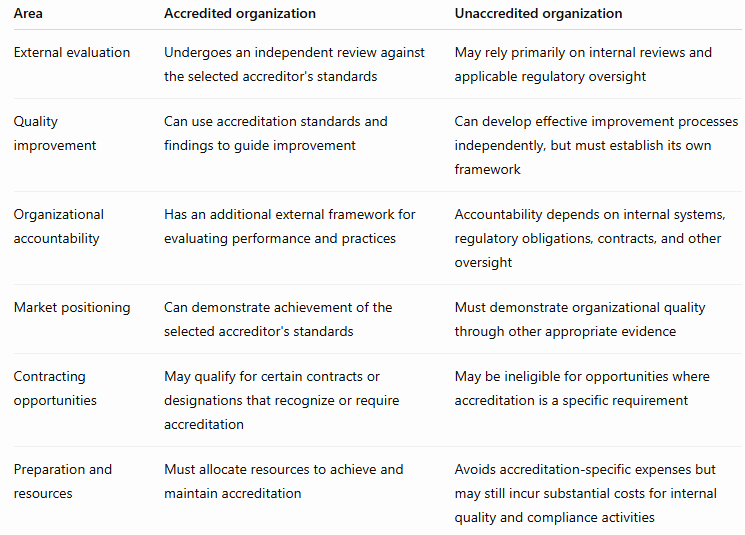
Neither approach automatically guarantees superior outcomes. The value of accreditation depends on the organization's needs, the relevance of the standards, and how effectively the organization applies what it learns.
1. Strengthening Quality of Care
One of the most important potential benefits of accreditation is the opportunity to examine how services are delivered and identify opportunities to improve them.
Behavioral healthcare organizations frequently develop policies and procedures to establish expectations for staff and maintain consistent practices. Over time, however, procedures can become outdated, practices can vary between programs, and opportunities for improvement can go unnoticed.
Accreditation provides a structured opportunity to evaluate these areas.
An external review may help an organization identify gaps involving documentation, service planning, staff training, risk management, or other practices relevant to its programs.
These findings can help leadership determine where additional guidance, revised procedures, or focused training may be appropriate.
For example, an organization may have a written policy requiring individualized treatment planning. A closer review may reveal that staff interpret the requirements differently or that documentation does not consistently reflect individual needs and goals.
Identifying the discrepancy creates an opportunity to address the underlying issue rather than simply reiterating the policy.
The goal is not merely to meet a standard. It is to develop practices that support meaningful, consistent, and person-centered services.
2. Creating a More Structured Approach to Continuous Improvement
Quality improvement should be an ongoing organizational responsibility, not an activity that occurs only before a survey or following an identified problem.
Accreditation can help organizations establish a more systematic approach to evaluating performance, identifying trends, assigning responsibility, and monitoring corrective actions.
This may include reviewing performance indicators, analyzing incident reports, examining grievances, evaluating documentation practices, and determining whether improvement initiatives are producing the intended results.
For example, an organization may identify recurring documentation errors during an internal review. Rather than correcting individual records and moving on, leadership can investigate the underlying causes.
Possible contributing factors might include unclear expectations, insufficient training, inconsistent supervision, or a documentation process that is difficult to follow.
An effective improvement process addresses the underlying issue, implements corrective action, and evaluates whether the changes are working.
Accreditation standards can help provide structure for this work, although organizations can and should pursue continuous improvement regardless of their accreditation status.
3. Strengthening Organizational Accountability
Behavioral healthcare leaders are responsible for ensuring that policies, procedures, and operational expectations are implemented throughout their organizations.
This can be challenging when an agency operates multiple programs, employs staff across different locations, or relies on supervisors who have several competing responsibilities.
Accreditation can provide an additional framework for evaluating whether responsibilities are clearly defined and whether organizational practices align with established expectations.
The preparation process may encourage leadership to examine questions such as:
Are responsibilities clearly assigned?
Are employees adequately trained for their roles?
Are policies being followed consistently?
Are performance concerns identified and addressed?
Are corrective actions documented and monitored?
Does leadership have reliable information about organizational performance?
These questions matter whether an organization is accredited or not.
However, an external evaluation can introduce an additional level of accountability and provide perspective that may be difficult to obtain through internal reviews alone.
4. Supporting Regulatory Compliance and Risk Management
Accreditation and regulatory compliance are related, but they are not interchangeable.
Behavioral healthcare providers must understand the federal, state, local, licensing, funding, and contractual requirements applicable to their particular services. Accreditation may supplement these obligations by providing additional standards for evaluating organizational practices.
Depending on the accreditor and the applicable program, accreditation preparation may help an organization identify gaps in policies, documentation, training, safety practices, and oversight.
It can also encourage leaders to examine whether their written procedures reflect actual operations.
For example, an organization may have a policy addressing incident reporting, but staff may not consistently follow the reporting process, or leadership may not regularly analyze incident trends.
Reviewing the policy alone would not resolve the problem. The organization must determine whether staff understand the process, whether reporting systems function appropriately, and whether identified trends lead to meaningful action.
An accreditation review can help draw attention to these types of organizational issues.
It is important to remember that accreditation does not eliminate compliance risk or guarantee that an organization meets every applicable legal requirement. Nor does accreditation automatically replace state inspections, licensing requirements, or other regulatory oversight.
Accreditation should complement a strong compliance program, not substitute for one.
5. Improving Credibility and Market Positioning
Behavioral healthcare organizations must demonstrate their capabilities to a range of stakeholders, including individuals seeking services, families, referral sources, community partners, payers, funding agencies, and prospective employees.
Accreditation can provide an additional way to demonstrate that an organization has undergone an independent evaluation against established standards.
This may be particularly valuable when an organization is seeking to expand services, strengthen community partnerships, pursue new contracts, or distinguish itself in a competitive market.
Accreditation may also be recognized or required by particular funders, payers, or governmental programs.
However, these benefits are not universal. The value of accreditation for contracting and reimbursement depends on the specific accreditor, program, jurisdiction, and contract. Organizations should confirm the requirements that apply to their circumstances rather than assume accreditation will automatically create new opportunities.
For organizations considering growth, this is an important strategic question: Will accreditation support the organization's ability to achieve its business and service-delivery goals?
The answer may depend on current contracts, future opportunities, community needs, and the organization's long-term plans.
6. Supporting Staff Training and Professional Development
A behavioral healthcare organization's effectiveness depends heavily on the people who deliver and support its services.
Employees need clear expectations, appropriate supervision, relevant training, and access to the resources required to perform their responsibilities.
Accreditation preparation can encourage organizations to evaluate whether these systems are working effectively.
For example, leadership may discover that orientation practices vary between departments, training records are incomplete, or supervisors need additional guidance on evaluating staff performance.
Addressing these issues can help create more consistent expectations and strengthen organizational practices.
Accreditation does require time and effort from employees, especially during preparation and survey periods. Without adequate planning, the additional workload can become burdensome.
Organizations can reduce unnecessary strain by assigning responsibilities clearly, developing a realistic preparation schedule, and integrating accreditation activities into routine operations instead of treating them as a last-minute project.
When approached thoughtfully, the process can support both organizational accountability and staff development.
7. Supporting Growth and Long-Term Sustainability
Accreditation can be particularly valuable for organizations planning to expand services, open new programs, serve additional populations, or strengthen existing operations.
Growth creates new demands involving staffing, supervision, documentation, training, quality assurance, financial management, and regulatory oversight.
An organization that expands without evaluating whether its systems can support the additional work may encounter operational problems that become increasingly difficult to resolve.
Accreditation preparation can provide an opportunity to assess these systems and identify areas that require attention.
For example, an agency considering an additional outpatient program may need to evaluate its workforce capacity, policies, referral processes, clinical oversight, documentation systems, and quality monitoring practices.
An external standards framework can help inform this assessment, although accreditation alone does not constitute a complete strategic plan or guarantee successful expansion.
Ultimately, sustainable growth requires alignment between an organization's mission, community needs, financial resources, workforce, operational capacity, and quality expectations.
Accreditation can contribute to that process when it is connected to broader organizational planning.
8. Understanding the Costs of Accreditation
Although accreditation can offer meaningful benefits, it also requires an investment.
Organizations may incur accreditor fees, staff training expenses, consulting costs, documentation and process improvement expenses, and the time required to prepare for and participate in surveys.
Leadership must consider these costs alongside other organizational priorities.
Smaller agencies and organizations operating with limited resources may be especially concerned about whether they can manage accreditation without disrupting daily services.
The decision should therefore be based on an informed assessment of both the investment and the potential value.
Questions worth considering include:
Is accreditation required by a current license, contract, payer, or program designation?
Are there future funding or contracting opportunities that depend on accreditation?
What operational or quality improvement needs could the process help address?
What internal resources would be required to prepare and maintain accreditation?
Are there significant gaps that should be addressed before beginning the process?
How does accreditation fit into the organization's strategic plan?
Organizations should also distinguish between the cost of accreditation itself and the resources needed to maintain effective operations. Unaccredited providers still need appropriate compliance oversight, staff training, quality improvement, and risk management.
Accreditation creates additional obligations, but the absence of accreditation does not eliminate the need for strong organizational systems.
Is Accreditation Right for Every Behavioral Health Organization?
Not necessarily. The decision depends on the organization's regulatory environment, service model, contractual obligations, resources, and strategic goals.
For some providers, accreditation may be essential because it is required for a particular designation, contract, or program. For others, it may be a strategic investment that supports quality improvement, credibility, or future growth.
Some organizations may need to strengthen their internal systems before pursuing accreditation. Others may already have mature processes and be well positioned to begin preparing.
Before making a decision, leadership should evaluate the specific requirements that apply to the organization and determine whether accreditation offers a clear benefit.
The key is to avoid viewing accreditation as either a universal requirement or an unnecessary administrative burden. It is a strategic decision that should be evaluated in the context of the organization's mission and operational needs.
How Brown Consulting Can Help
Preparing for accreditation can be challenging, particularly for behavioral healthcare organizations whose leaders and staff are already managing demanding responsibilities.
The process involves more than assembling documents. Organizations need to understand applicable standards, evaluate current practices, identify gaps, establish priorities, and develop realistic plans for addressing areas that require improvement.
Brown Consulting provides behavioral healthcare consulting services to organizations throughout the United States, with support tailored to each organization's needs.
Our services can help organizations evaluate their readiness, strengthen regulatory compliance practices, review policies and procedures, support performance improvement, and prepare for accreditation-related activities.
For organizations that are not yet ready to pursue accreditation, consulting support can also help identify opportunities to strengthen internal systems and establish a foundation for future development.
Whether an organization is preparing for its first accreditation survey, maintaining existing accreditation, or evaluating whether accreditation is the right next step, an informed assessment can help leadership make decisions with greater clarity.
Accreditation is not simply about passing a survey. It is about building organizational practices that support quality, accountability, and sustainable service delivery.
Take the Next Step
Every behavioral healthcare organization has different needs, challenges, and goals. Understanding the benefits, costs, and requirements of accreditation is an important part of deciding what is right for your organization.
If your organization is considering accreditation or would benefit from an independent review of its compliance, quality improvement, or operational practices, Brown Consulting can help you evaluate your options and determine a practical path forward.
Visit https://www.brownconsultingltd.com/ to learn more about our behavioral healthcare consulting, accreditation, and regulatory compliance services.
Brown Consulting supports behavioral healthcare organizations in strengthening the systems and practices that help them deliver quality services and sustain their missions.
