

Medicaid changes are coming that could significantly affect behavioral healthcare organizations, their patients, and the way services are funded and delivered. Signed into law on July 4, 2025, the Working Families Tax Cut legislation (Public Law 119-21), also known as the One Big Beautiful Bill Act, introduces substantial changes to Medicaid eligibility, enrollment, and financing.
For behavioral healthcare organizations that rely heavily on Medicaid reimbursement, these changes deserve immediate attention. Mental health providers, substance use disorder treatment facilities, addiction treatment programs, residential treatment providers, and community-based behavioral health organizations may experience changes in patient eligibility, service utilization, reimbursement structures, and financial stability.
While some provisions are already in effect, others will be implemented over the next several years. Understanding what is changing, when the changes take effect, and how they may affect operations is essential for organizational leadership.
Here is what behavioral healthcare providers need to know.
1. What Changed Under the 2025 Medicaid Legislation?
The legislation introduces several significant changes to Medicaid. Although not every provision directly regulates behavioral healthcare providers, many could have downstream effects on organizations that depend on Medicaid-funded services.
The most important areas for behavioral healthcare organizations to monitor include:
Medicaid Community Engagement Requirements
Beginning January 1, 2027, states must generally implement new community engagement requirements for certain Medicaid beneficiaries. States may implement these requirements earlier.
Under the new requirements, certain adults will need to demonstrate at least 80 hours per month of qualifying activities to maintain Medicaid eligibility. Qualifying activities include:
Employment.
Community service.
Participation in qualifying work programs.
Enrollment in an educational program at least half-time.
A combination of qualifying activities totaling at least 80 hours per month.
Meeting the applicable monthly income threshold.
The requirements generally apply to nonpregnant adults ages 19 through 64 who are enrolled in the Medicaid expansion adult group or certain qualifying Section 1115 demonstration populations.
Importantly, not everyone enrolled in Medicaid will be subject to these requirements. Certain individuals are exempt, including people who are medically frail, pregnant, or postpartum, certain caregivers, and individuals participating in drug or alcohol rehabilitation or treatment programs, among other exempt groups.
Why this matters to behavioral healthcare providers:
Changes in Medicaid eligibility could affect the number of individuals who maintain coverage and have access to behavioral healthcare services.
Organizations serving adults with mental health conditions, substance use disorders, and other complex needs should pay particular attention to how eligibility determinations and exemptions are administered.
Providers should also recognize that some patients may qualify for an exemption but experience difficulties navigating the application, verification, and renewal process.
Helping patients understand coverage requirements and connecting them with appropriate enrollment assistance may become increasingly important.
More Frequent Medicaid Eligibility Redeterminations
Another significant change involves the frequency of Medicaid eligibility reviews.
Beginning with renewals scheduled on or after January 1, 2027, states must generally conduct eligibility redeterminations every six months for most individuals enrolled through the Medicaid expansion adult group.
Previously, these individuals generally received annual eligibility reviews.
This change could create additional administrative requirements for state Medicaid agencies and increase the frequency with which eligible individuals must verify their continued eligibility.
Why this matters to behavioral healthcare providers:
More frequent eligibility reviews could increase the likelihood of coverage interruptions when individuals fail to complete required paperwork, respond to notices, or provide requested documentation.
For providers, coverage interruptions may result in:
Increased patient financial responsibility.
Delayed or denied reimbursement.
Higher uncompensated care.
Interrupted treatment services.
Additional administrative work related to insurance verification and billing.
Behavioral healthcare organizations should consider how more frequent eligibility reviews could affect patient retention, continuity of care, and revenue.
Changes to Medicaid Provider Taxes and State Financing
The legislation also introduces significant restrictions on how states finance their Medicaid programs through healthcare-related provider taxes. Provider taxes have historically been one mechanism states use to generate funding for Medicaid and obtain federal matching funds. The new legislation restricts certain provider tax arrangements and limits the ability of states to establish new taxes or increase existing taxes.
Some changes began taking effect in 2025 and 2026, with additional restrictions scheduled for October 1, 2027, depending on the applicable tax category and state circumstances. CMS has also issued guidance and proposed regulations addressing implementation of these changes.
Why this matters to behavioral healthcare providers:
Although these provisions primarily affect state Medicaid financing systems, they could have indirect consequences for behavioral healthcare organizations. States facing changes in Medicaid financing may reevaluate budgets, reimbursement strategies, provider payment arrangements, and program funding priorities.
Organizations should not assume that reimbursement rates will automatically decrease as a result of these provisions. However, Medicaid-dependent providers should closely monitor state budget decisions and potential changes to their Medicaid programs.
Changes to Medicaid State-Directed Payments
The legislation also establishes new limitations on certain Medicaid state-directed payments. State-directed payments allow states to direct Medicaid managed care organizations to make specified payments to providers under approved arrangements. The legislation establishes payment limits for certain inpatient hospital services, outpatient hospital services, nursing facility services, and qualifying practitioner services at academic medical centers.
For applicable payment arrangements, the limits generally are 100% of Medicare rates in Medicaid expansion states and 110% in non-expansion states, subject to the law's grandfathering provisions. Certain existing arrangements may qualify for temporary grandfathering, with a transition period beginning in 2028.
Why this matters to behavioral healthcare providers:
The direct impact will depend on the types of services provided, the organization's payment arrangements, and whether it participates in affected Medicaid managed care programs. Behavioral healthcare organizations should monitor state Medicaid managed care contracts and any changes to payment arrangements that could affect their programs or affiliated healthcare systems.
Additional Changes to Medicaid Waivers and Financing
The legislation also changes certain requirements involving Section 1115 Medicaid demonstration projects.
Beginning January 1, 2027, new budget neutrality requirements will apply to certain Section 1115 demonstrations.
These demonstrations can be used by states to test new approaches to Medicaid coverage, service delivery, and financing.
Why this matters to behavioral healthcare providers:
Organizations participating in Medicaid demonstration programs or operating under state-specific Medicaid initiatives should monitor changes to waiver funding, program requirements, and service delivery arrangements.
Changes to these programs could affect behavioral healthcare initiatives, reimbursement opportunities, and the availability of certain services.
2. Who Will Be Affected?
The impact of these Medicaid changes will vary depending on the organization's services, patient population, payer mix, and state Medicaid program. However, organizations that rely heavily on Medicaid funding should pay particular attention.
Affected provider types may include:
Community mental health agencies.
Outpatient mental health providers.
Substance use disorder treatment facilities.
Addiction treatment programs.
Residential treatment facilities.
Community-based behavioral healthcare organizations.
Certified Community Behavioral Health Clinics (CCBHCs).
Organizations providing Medicaid-funded case management and support services.
Behavioral healthcare organizations participating in Medicaid managed care networks.
Organizations serving individuals enrolled in Medicaid expansion programs may be particularly affected by the new eligibility requirements and more frequent redeterminations. Providers serving individuals with complex behavioral health needs should also understand the exemptions available under the community engagement requirements, including the exemption for participants in qualifying drug or alcohol rehabilitation or treatment programs.
3. When Do the Changes Take Effect?
Not all provisions become effective at the same time. Some changes are already in effect, while others have implementation dates extending through 2028 and beyond.
Important dates include:
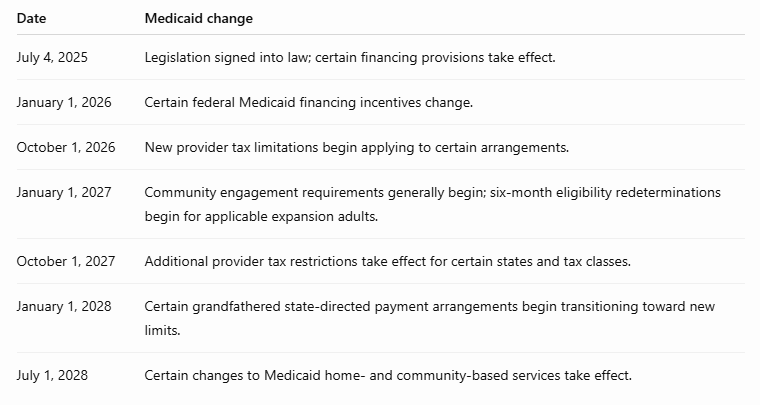
States are responsible for implementing many of these requirements. Consequently, the timing and operational details may vary depending on state Medicaid programs and applicable federal guidance. Organizations should monitor CMS announcements and their state Medicaid agency for updated implementation instructions.
4. What Should Behavioral Healthcare Organizations Review?
The legislation creates an opportunity for behavioral healthcare organizations to evaluate whether their current operations, financial planning, and compliance programs are prepared for potential changes.
Leadership should consider reviewing the following areas:
Medicaid Revenue and Financial Planning
Evaluate how dependent the organization is on Medicaid reimbursement.
Consider:
What percentage of organizational revenue comes from Medicaid?
Which programs rely most heavily on Medicaid-funded services?
How would changes in patient eligibility affect revenue?
Are current reimbursement rates sufficient to support program operations?
Does the organization have adequate financial reserves to manage potential reimbursement interruptions?
Leadership should also evaluate the potential financial impact of increased uncompensated care and changes in patient coverage.
Patient Eligibility and Insurance Verification
Review current procedures for verifying patient insurance coverage and identifying eligibility changes. Organizations should consider whether their administrative processes can accommodate more frequent eligibility reviews and potential coverage interruptions. Staff should understand how to help patients navigate insurance verification, Medicaid renewal notices, and referrals to appropriate enrollment resources.
Policies and Procedures
Review policies and procedures related to:
Patient registration and eligibility verification.
Financial responsibility and billing.
Insurance authorization.
Continuity of care.
Discharge planning.
Referrals and care coordination.
Documentation of services.
Medicaid compliance and reimbursement.
Policies should reflect applicable state Medicaid requirements and organizational responsibilities.
Staffing and Operational Capacity
Changes in Medicaid eligibility and reimbursement could affect patient volume, staffing needs, and program capacity. Organizations should evaluate whether current staffing structures can accommodate changes in administrative workloads, patient needs, and financial resources. Leadership should also consider whether additional staff training is necessary to help employees understand changes affecting Medicaid beneficiaries.
Quality Assurance and Performance Improvement
Organizations should evaluate how Medicaid changes could affect quality indicators and organizational performance.
Potential areas to monitor include:
Patient retention.
Treatment interruptions.
Missed appointments.
Discharge rates.
Uncompensated services.
Insurance-related denials.
Authorization delays.
Changes in patient access to care.
Tracking these indicators can help leadership identify emerging problems and develop corrective action plans before they negatively affect organizational performance.
5. What Steps Should Leadership Take to Prepare?
Preparing for Medicaid changes requires more than reviewing new regulations. Organizations should take a proactive approach that incorporates compliance, financial planning, operational readiness, and ongoing performance monitoring.
Consider the following steps:
1. Conduct an Organizational Impact Assessment
Evaluate how the Medicaid changes may affect your organization's programs, patients, funding, and operations. Identify which provisions are most relevant to your organization based on your state, payer mix, and services.
2. Evaluate Financial Risk
Review Medicaid revenue, reimbursement trends, payer mix, and potential exposure to coverage interruptions. Develop financial projections that account for possible changes in patient volume and uncompensated care.
3. Review Policies and Procedures
Ensure that policies addressing patient eligibility, insurance verification, billing, documentation, and continuity of care reflect applicable requirements. Update procedures when necessary and communicate changes to affected staff.
4. Educate Leadership and Employees
Ensure executive leadership, clinical directors, billing personnel, compliance officers, and administrative staff understand the changes that may affect their responsibilities. Training should address both regulatory expectations and practical operational implications.
5. Monitor State Medicaid Developments
Federal legislation establishes the framework, but states will play a significant role in implementing many of the changes. Monitor state Medicaid agency announcements, managed care contract updates, reimbursement guidance, and implementation deadlines.
6. Strengthen Performance Monitoring
Establish or review performance indicators that help leadership monitor revenue, patient access, service utilization, and compliance. Use this information to identify trends, assess organizational risk, and implement improvements as needed.
7. Develop a Proactive Action Plan
Assign responsibility for monitoring regulatory developments and implementing necessary changes. Set timelines, identify resources, and periodically evaluate progress to keep the organization prepared.
6. How Brown Consulting Can Help
Regulatory changes can create significant challenges for behavioral healthcare organizations, particularly those already managing limited staffing, financial pressures, and increasing compliance responsibilities. Understanding new requirements is only the first step. Organizations must also determine how those requirements affect their individual programs, policies, operations, and long-term sustainability.
Brown Consulting has more than 38 years of experience providing consulting services to mental health, substance use, addiction treatment, and behavioral healthcare organizations throughout the United States.
Our consultants help organizations navigate regulatory and operational challenges through services that include:
Regulatory Compliance: Reviewing organizational policies, procedures, and practices to identify potential compliance gaps and areas requiring attention.
Accreditation: Helping organizations strengthen operational practices, documentation, and compliance with applicable accreditation standards.
Strategic Planning: Evaluating organizational priorities, financial considerations, service delivery, and long-term sustainability.
Performance Improvement: Helping organizations develop meaningful performance indicators, monitor outcomes, identify trends, and implement corrective action plans.
Operational Support: Evaluating organizational processes and identifying opportunities to improve efficiency, accountability, and service delivery.
Staff Training: Helping leadership and employees understand regulatory expectations and their responsibilities.
Our approach is practical and customized to the needs of each organization. We recognize that regulatory changes do not affect every provider in the same way, and recommendations should reflect the organization's services, resources, and operational structure.
Preparing Today for Tomorrow's Regulatory Challenges
The 2025 Working Families Tax Cut legislation represents a significant shift in Medicaid eligibility and financing. While many of the changes will be implemented over time, behavioral healthcare organizations should not wait until new requirements take effect to evaluate their potential impact. Changes in Medicaid eligibility, patient coverage, state financing, and reimbursement arrangements could create operational and financial challenges for providers that are not adequately prepared. Leadership should begin reviewing organizational exposure, strengthening compliance practices, evaluating financial sustainability, and establishing a plan for responding to regulatory changes.
Staying informed, prepared, and proactive can help your organization navigate changing requirements while continuing to provide essential behavioral healthcare services to the communities you serve.
Need Help Preparing Your Organization?
Brown Consulting provides experienced behavioral health consulting services to organizations throughout the United States.
Contact Brown Consulting to discuss your organization's regulatory compliance, operational, accreditation, and performance improvement needs.
Brown Consulting
Behavioral Health Consulting Since 1987
https://www.brownconsultingltd.com/
Give us a call today! 800-495-
